Best Planted Tank Lights 2026
Research-based 2026 guide to Fluval Plant 3.0, Chihiros, Twinstar, and Hygger planted aquarium lights.
Table of Contents
Affiliate Disclosure: We may earn a commission if you purchase through our links. This does not change the price you pay. How the desk is funded: How We Make Money.
This is a research-based guide, not a hands-on test. We compare manufacturer specifications, current US retail listings, and the patterns that show up in published owner reports. We do not invent lab PAR maps, credentials, or prices. Amazon product links on this page use the Associates tag plantedtankreviews-20. You do not pay more when you use them. Retail prices move; we hedge dollar talk on purpose and tell you to check the live listing. Scope is freshwater planted-tank hardware. We do not stock livestock, review live plants as products, diagnose disease, or recommend medications.
US search interest for planted tank light and best aquarium light for plants is why this page exists. The shortlist people actually type is Fluval Plant 3.0, Chihiros, Twinstar, and Hygger — not a generic "best LED" list with unnamed bars.
If you are also shopping filtration or a 20-gallon stack, read the filter pillar and the 20-gallon hardware guide after this one. The named-SKU light compare lives at Fluval Plant 3.0 vs Chihiros vs Twinstar.
This page is the category shop: four product ideas including Hygger, a length table, and a used-bar note. The three-name compare is a decision matrix for people who already typed Fluval, Chihiros, and Twinstar. Keep both URLs. If you already know those three names, use the compare. If you are still choosing a product idea, stay here.
What a planted light has to do
A planted-tank light is not a display lamp that happens to sit on glass. It has to deliver a usable spectrum across the bed, last through a daily photoperiod without cooking the water, and give you some way to shorten or dim the day when algae gets ahead of plant mass.
Fluval's own product pages for Plant 3.0 describe six LED band waves, a programmable 24-hour cycle (sunrise, midday, sunset, night), optional habitat presets including a planted mode, about 120 degrees of dispersion, and extendable brackets. Fluval publishes four lengths: 22W for 15–24 inches, 32W for 24–34 inches, 46W for 36–48 inches, and 59W for the mid-four-foot class. That length map matters more than brand loyalty. A 59W bar on a 10-gallon cube is the wrong object.
Chihiros WRGB II is a different product idea: independent red, green, and blue channels in the My Chihiros app, built-in Bluetooth, sliding stainless stands, and a high-output RGB chip set aimed at aquascaping color. Twinstar's current A-Line and B-Line bars are slim RGB+W fixtures with extendable legs and a quieter visual profile. Hygger's Advanced / 978-class bars put the timer on the controller so you do not need a phone.
One vocabulary note before the spec talk. "PAR" — photosynthetically active radiation — is the 400–700 nanometer band of light plants actually use, and it is the honest way to talk about intensity; Wikipedia's overview of photosynthetically active radiation is a serviceable primer. Growers who publish their full method, such as 2Hr Aquarist, talk about light in terms of output at the substrate and a matching photoperiod — not watts per gallon. If a listing tells you nothing about output beyond "full spectrum," treat the intensity claim as marketing until the manufacturer publishes numbers.
None of these lights replace fertilizer, CO2, or filter flow. Light is one lever. If you buy a Chihiros-class bar and run it at 100 percent for twelve hours on a fresh soil bed, you will grow algae as efficiently as plants. That is a scheduling problem, not a reason to invent a "best wattage per gallon" rule.
How we compared these four lines
We scored each line on:
- Documented spectrum and control. App channels versus onboard timer versus a wall wart and a mechanical timer.
- Length coverage. Whether a current US listing exists for the tank sizes people actually buy (10, 20, 29, 40).
- Service reality. Brackets, adapters, and whether the listing is a real current ASIN.
- Honesty about intensity. Mid-tier Bluetooth bars are not high-PAR scaper lights. We say so.
We did not invent PAR maps. If a manufacturer does not publish a PAR grid for a SKU, we do not pretend we measured one.
Buy the row, not the brand
A bar that does not span the rim is a return in transit. Measure the glass before you shop, then buy the wattage row whose published range brackets your measurement:
| Tank (US name) | Rim length (typical) | Plant 3.0 row | Notes |
|---|---|---|---|
| 10-gallon cube | 12–16 in | 22W is the only close row | Its published range starts at 15 in; a 12 in cube sits under it. Measure. |
| 10-gallon standard | 20 in | 22W | Comfortable. Twinstar 45A (18–23 in) and the hygger 18–24 in row also land here. |
| 20-gallon high | 24 in | 22W at the top of its range, or 32W for headroom | The 32W range starts at 24 in exactly. |
| 20-gallon long | 30 in | 32W | The 22W is too short. Brackets do not invent length. |
| 29-gallon | 30 in | 32W | Same glass length as a 20-long. |
| 40-breeder | 36 in | 46W | The 32W tops out at 34 in. |
| 55-gallon class | 48 in | 59W | Fluval's mid-four-foot row. |
Chihiros sizes bars in centimeters, with published SKUs running from roughly 30 cm up through 120 cm. One inch is 2.54 cm, so a 24 inch rim is a ~60 cm class row — pick the SKU at or just wider than the glass, and read the stand's glass-thickness limit before you click.
Fluval Plant 3.0
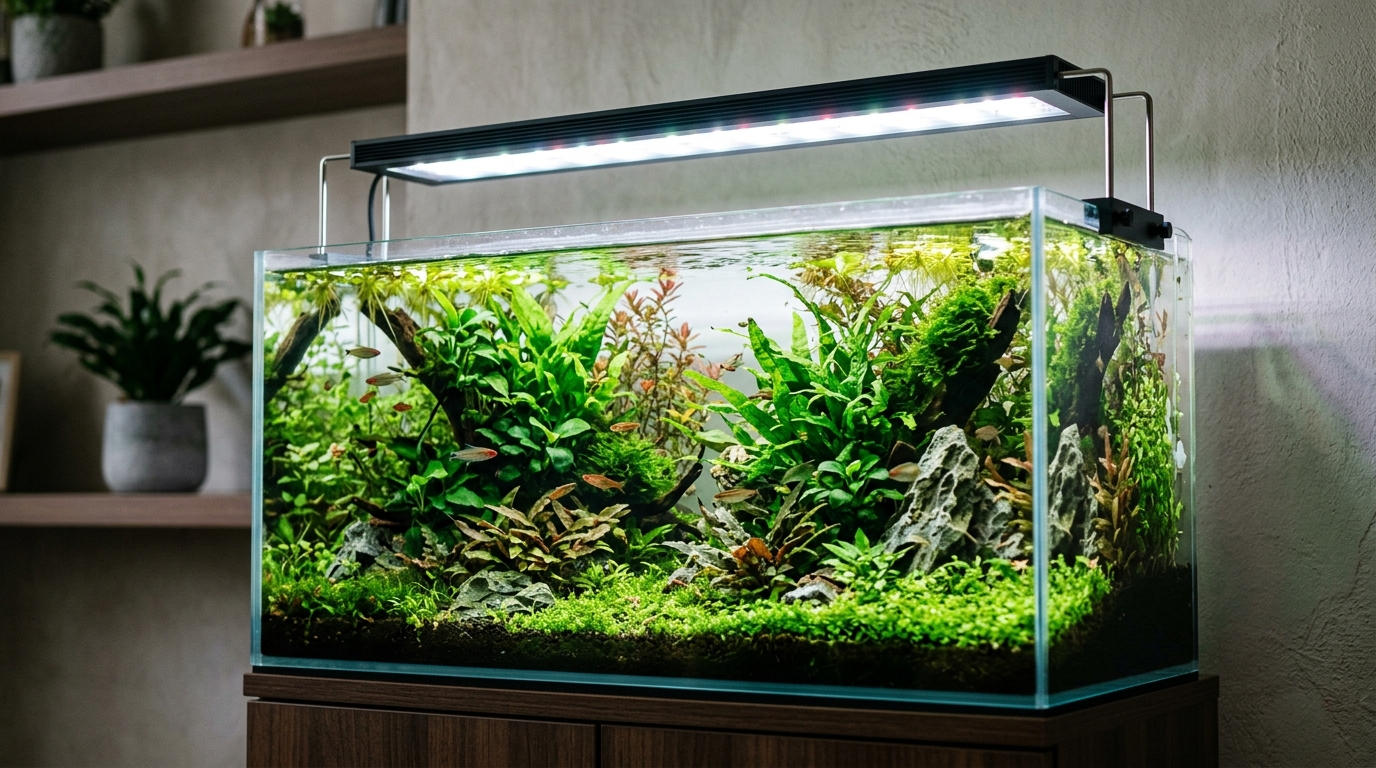
Fluval's Plant Spectrum 3.0 is the default "named planted light" in US retail. The 22W listing (B083QP62MP) is specified for 15–24 inch tanks. The 32W listing (B07BBWSPRC) is specified for 24–34 inch tanks. Those two sizes cover most 10-gallon, 20-gallon high, and 20-gallon long rims.
What you are buying is not raw intensity. You are buying a German-engineered (Fluval's wording) aluminum bar with FluvalSmart scheduling, a planted preset, and a three-year warranty claim on the series. The app lets you ramp sunrise and sunset instead of slamming a mechanical timer. That ramp is useful on a new tank because it reduces the "lights on, algae on" cliff.
Where Plant 3.0 loses is ceiling. Chihiros WRGB II is the light people buy when they want more punch and channel-level RGB. Twinstar is the light people buy when they want a slim bar that disappears over a rimless tank. Hygger is the light people buy when they refuse to pay mid-tier Bluetooth money for a first tank.
Plant 3.0 is the right default when you want a documented planted preset, a brand with US parts distribution, and a length that matches a standard rim. It is the wrong default when you already know you want high-demand carpets and independent RGB.
Fluval Plant 3.0 LED (22W, 15–24 in)
Fluval
Bluetooth-controlled Fluval Plant Spectrum 3.0 LED for 15–24 inch planted tanks, with a programmable 24-hour cycle and six LED band waves.
Fluval Plant 3.0 LED (32W, 24–34 in)
Fluval
Larger Plant Spectrum 3.0 bar for 24–34 inch tanks, same six-band spectrum and FluvalSmart scheduling as the 22W size.
Before you click. The 22W Plant 3.0 is a 15–24 inch row. The 32W is a 24–34 inch row. A 20-gallon long is usually a 30-inch class tank — do not buy the 22W card and hope brackets invent length. Confirm wattage and fit range in the live title, and that the photo still includes the adapter brick and stands for that length.
Chihiros WRGB II
Chihiros WRGB II (search current listings) is the named Chihiros line in this pillar. The listing describes sunrise/sunset programming, independent RGB channels, and sliding stainless stands. Specialist retailers publish length SKUs from 30 cm up through 120 cm with wattage and lumen tables that sit well above Fluval's 22W class.
That intensity is the feature and the risk. A WRGB II on a shallow 20-gallon can grow demanding stems. It can also grow film algae if you treat it like a display lamp and leave it wide open. Start with a shorter photoperiod and raise intensity after plants show new growth — that is husbandry, not a secret test protocol.
Mounting is the other gotcha. Chihiros stands assume a glass thickness limit. Thick-rimmed American kits may need a hang-on kit sold separately. Read the length and glass-thickness line before you click.
WRGB II is the pick when control and intensity matter more than a Fluval preset. It is not the pick when you want the cheapest timed bar.
Chihiros WRGB II
Chihiros
App-controlled Chihiros WRGB II RGB bar with sunrise/sunset scheduling and sliding stainless stands for rimless planted tanks.
Before you click. Confirm the length in centimeters and whether the live row includes stands or a hang-on kit that matches your glass thickness. A WRGB II photo on a rimless tank does not prove a thick-rim American kit is in the box. Chihiros cm sizes do not map 1:1 to a US "20-gallon" name. Measure the glass.
Twinstar A-Line
Twinstar is the third name people type next to Fluval and Chihiros. The current US A-Line 45A (B08P91X8V2) is listed for about 18–23 inch tanks with RGB+W diodes and extendable legs. Twinstar also sells B-Line bars (for example the 90B at B08LMYQLMP) as a lower-output slim series.
A-Line is a design-first bar. The aluminum unibody is thin. Heat is modest. The look is the point for rimless tanks. The tradeoff is output: this is a low- to medium-light planted fixture, not a WRGB II substitute. If your plan is a high-energy stem tank, Twinstar's higher lines exist, but we only link SKUs we can verify.
Buy Twinstar when the tank is a display piece and the plant list is Anubias, Java fern, Bucephalandra, and easy stems. If the display-piece route is the plan, the outflow hardware is furniture too — glass versus steel versus PETG gets decided in the lily pipe guide. Do not buy A-Line to "max out" a carpet.
Twinstar A-Line 45A
TWINSTAR
Slim Twinstar A-Line RGB+W LED for roughly 18–23 inch tanks, with extendable legs and a low-profile aluminum body.
Before you click. Confirm A-Line versus B-Line in the title. The 45A is an 18–23 inch class bar, not a 30-inch 20-gallon long. Slim is not a wattage class. If the marketplace row swapped a B-Line photo onto an A-Line title, walk away.
Hygger Advanced LED
Hygger is the budget pole. The Advanced LED for 18–24 inch tanks (B08N4SNCRS) documents a 24/7 cycle, DIY color modes, and a built-in timer. You do not need Bluetooth. You do not get Chihiros-level channel math.
That is enough for a first planted 20-gallon if you keep the photoperiod honest and the plant list modest. It is not enough if you are shopping for a named scaper light. Hygger generations change controllers often; buy the current listing, keep the adapter dry, and do not assume every hygger SKU is the same fixture.
hygger Advanced LED (18–24 in)
hygger
Budget full-spectrum hygger 978-class bar with a built-in timer, 24/7 cycle, and DIY color modes for 18–24 inch freshwater tanks.
Before you click. Hygger generations change controllers. Confirm the 18–24 inch Advanced LED row, not every hygger SKU on the shelf. "Full spectrum" on a budget title is usually white diodes plus a few red and blue chips — enough for a modest plant list, not a Chihiros substitute.
Photoperiod: the free upgrade
The most effective upgrade on this page costs nothing: the schedule. Planted-tank writers who publish their full method — 2Hr Aquarist is the best-known example — treat photoperiod as a dial you turn with plant mass, not a setting you copy once and forget. Beginner-oriented retailers make the same point with less theory; Aquarium Co-Op's planted-tank articles are a sane second read.
The practical version: start a new tank around six hours a day, hold that until plants are visibly putting out new growth, then step toward eight. If algae arrives first, shorten the day or dim the bar before you buy anything. On bars that ramp — Plant 3.0 and WRGB II both do — let the ramp handle transitions. An instant jump from blackout to full output is the fastest way to open the buffet.
Buying notes the listing will not write
Adapter bricks fail more often than LED boards. Keep the brick off the wet rim. Use a drip loop. If a bar dies six months in, the first question is whether the supply got wet, not whether the brand "is junk."
A 24-hour "sunrise to moonlight" program is a convenience, not a growing requirement. Write six to eight hours on a note. Moonlight is viewing, not extra photoperiod. That sentence will not appear next to "Check Current Price."
The used-bar note
The cheapest way into a Fluval- or Twinstar-class fixture is secondhand, and the risks are boring. The power brick goes missing first: LED bars expect a specific supply, and a wrong-voltage replacement can dim the bar or damage it, while manufacturer-branded replacements are not always sold separately. Stands and legs go missing just as often, and a bar without mounting legs for your rim is a DIY hang-on project you did not sign up for. Before buying used, ask the seller for the adapter's model number and both legs, and treat corrosion on the rail or connector as a walk-away. The diodes themselves are usually the most durable part of the package.
The named three-way — Fluval vs Chihiros vs Twinstar — lives at Fluval Plant 3.0 vs Chihiros vs Twinstar. A 20-gallon high-versus-long shopping order lives in best light and filter for a 20-gallon planted tank.
The rest of the hardware stack
A light never works alone. The pages that pair with this one:
- Soil. A high-output bar over inert sand is wasted intensity. The substrate guide is the upstream decision on a fresh build.
- CO2. The brighter the bar, the faster plants burn carbon. Mid-tier and up lighting raises the CO2 kit question honestly instead of letting it surprise you.
- Filtration. Flow decides whether nutrients actually reach every plant. The filter pillar covers the classes; the Fluval 107 vs AquaClear 50 compare is the 10–20 gallon shortcut.
- Heat. Lighting adds little thermal load next to a heater; the heater guide is where temperature stability actually lives.
- Outflow. On a rimless display tank the return pipe is furniture — glass versus steel versus PETG is decided in the lily pipe guide.
Building a 20-gallon from scratch? The 20-gallon light and filter guide sequences the whole order in one place.
Common questions about planted tank lights
What light do most 20-gallon planted tanks actually need?
A 22W Fluval Plant 3.0 or an 18–24 inch hygger Advanced LED covers most low- to medium-light 20-gallon planted tanks. Step up to Chihiros WRGB II if you want independent RGB channels and higher intensity. The 20-gallon hardware guide walks the high-versus-long shopping order.
Is Fluval Plant 3.0 enough for carpeting plants?
Plant 3.0 is a mid-tier full-spectrum bar. It is a reasonable match for many stems and epiphytes. High-demand carpets usually want more intensity and tighter control than the 22W class provides — and usually injected CO2 as well, which is its own decision in the CO2 kit guide.
Do I need a phone app?
No. Hygger and many timer bars work without an app. Fluval Plant 3.0 and Chihiros WRGB II use Bluetooth apps for schedules and color channels.
When should I skip Chihiros WRGB II?
Skip it on a first modest plant list with a six-to-eight-hour day, or if you refuse both a phone app and a wall timer. Buy Fluval Plant 3.0 for a planted preset, or hygger if you want a timer on the controller.
Which light SKU fits a 10-gallon cube?
A 10-gallon cube is usually a 12–16 inch class tank. Fluval Plant 3.0 22W covers 15–24 inches. Measure the glass. Do not buy the 32W or a Twinstar 45A and hope brackets invent a fit.
Which light for which tank
| Tank length | Default research pick | Step-up | Budget |
|---|---|---|---|
| 15–24 in (many 10s and 20-highs) | Fluval Plant 3.0 22W | Chihiros WRGB II in the matching cm size | hygger Advanced 18–24 in |
| 24–34 in (20-long, many 29s) | Fluval Plant 3.0 32W | Chihiros WRGB II 60-class | hygger in the matching length |
| Rimless display, low–medium light | Twinstar A-Line sized to the glass | Chihiros if you later want more punch | hygger if budget leads |
A 20-gallon long is usually a 30-inch class tank. Do not buy the 22W Plant 3.0 for that footprint and hope brackets invent length. Measure the glass, then pick the row.
Photoperiod, not magic wattage
Published planted-tank practice clusters around a 6–8 hour core photoperiod for new tanks, then a slow stretch if plants are using the light. A 24-hour "sunrise to moonlight" program is a convenience, not a requirement. If your controller has a moonlight, treat it as a viewing mode, not extra growing hours.
We will not quote a dollars-and-cents street price. Mid-tier Bluetooth bars often live in the low-to-mid hundreds; hygger bars often live well below that; Chihiros WRGB lengths climb as the bar gets longer. Check the live Amazon listing.
What we are not recommending
- Random no-name "full spectrum" bars with no model number.
- Reef-oriented fixtures hung over a freshwater scape.
- Under-cabinet white strips. They photograph badly and grow algae in stripes.
- Stacking two mismatched bars "for more PAR" without a plan.
Related hardware
Light is the first pillar. Substrate chemistry is the second — see best substrate for a planted tank. If you add pressurized CO2, the CO2 kit guide is the next hardware decision. Filters and heaters are covered in the HOB vs canister and heater pillars. The named 10–20 gallon filter fight is Fluval 107 vs AquaClear 50. A later canister outflow lives on best lily pipe for a planted tank. The named three-SKU fight is Fluval Plant 3.0 vs Chihiros vs Twinstar. If the tank is already a 20-gallon, use best light and filter for a 20-gallon planted tank.
Quick Verdict
Rating: 8.2 / 10
The Fluval Plant 3.0 is the default named planted light in US retail — documented length rows for standard rims, a planted preset with sunrise-sunset ramping, and a three-year warranty claim on the series — with intensity ceiling as the honest limit: high-demand carpets and channel-level RGB belong to Chihiros.
FAQ
Can I run Plant 3.0 without the app? You can power the bar. The reason to buy Plant 3.0 is the schedule. If you refuse apps, buy hygger or put any bar on a mechanical timer.
Is Bluetooth in a wet room a problem? Keep the phone away from splash. Pair once, then leave the schedule on the fixture. That is ordinary wet-room hygiene, not a special Fluval flaw.
Do I need CO2 if I buy Chihiros? No. High light without carbon and fertilizer is how people grow algae. Match intensity to the rest of the stack.
What about the Fluval 3.0 46W and 59W? They exist for longer tanks. This pillar focuses on the sizes that match 10–20 gallon planted hardware. If your tank is four feet, buy the matching Plant 3.0 length or a Chihiros 90/120 — do not stretch a 32W bar with hope.
When should I skip Chihiros WRGB II? Skip it on a first modest plant list with a six-to-eight-hour day, or if you refuse both a phone app and a wall timer. Buy Fluval Plant 3.0 for a planted preset, or hygger if you want a timer on the controller.
Which light SKU fits a 10-gallon cube? A 10-gallon cube is usually a 12–16 inch class tank. Fluval Plant 3.0 22W covers 15–24 inches. Measure the glass. Do not buy the 32W or a Twinstar 45A and hope brackets invent a fit.
Listing check
Amazon titles for planted lights reuse "full spectrum," "sunrise," and a tank-length range that may not match the bar in the photo. Before you follow a plantedtankreviews-20 link on this page, confirm three things the listing copy usually buries:
- The wattage and fit range still match the ASIN we named. 22W Plant 3.0 is a 15–24 inch row. 32W is a 24–34 inch row. Hygger generations change controllers; the 18–24 inch Advanced LED is not every hygger SKU on the shelf.
- The box photo still includes the adapter brick and the stands or brackets for that length. Missing brackets are a defect, not a "you already have a rim" assumption.
- The seller line is the brand or a known importer. Walk away when the photo does not match the title.
We do not paste Amazon bullet lists into this guide. If a listing dropped a length SKU or swapped a controller generation, believe the live page, not a screenshot in our article.
How to read a light listing without getting fooled
Retail titles lie in small ways. "Full spectrum" on a budget bar often means white diodes plus a few red and blue chips. That can still grow easy plants. It is not the same as Fluval publishing six band waves or Chihiros publishing independent RGB channels. When a listing does not name a model, wattage, and fit length, skip it. This site will not invent a SKU to fill a table.
Also read the fit range as a range, not a promise. Extendable brackets add a few inches. They do not turn a 15–24 inch bar into a 30-inch bar. If the glass is 30 inches, buy the 24–34 inch class. If the glass is 24 inches, the 22W Plant 3.0 and the 18–24 inch hygger are the rows that match.
Adapter bricks fail more often than LED boards. Keep the brick off the wet rim. Use a drip loop. If a bar dies six months in, the first question is whether the supply got wet, not whether the brand "is junk." That is ordinary electronics, not a persona test.
Algae is usually a schedule problem
People blame lights when the photoperiod is twelve hours at 100 percent on a new bed. A planted tank with little leaf area cannot use that photon budget. Shorten the day. Dim the bar if the controller allows it. Add plant mass — that is horticulture hardware (stems you already own), not a livestock essay. Then raise intensity.
Moonlight modes are for viewing. They are not extra growing hours. If your hygger or Fluval schedule includes a long blue night, treat it as decoration and keep it short.
Buying used
A used Plant 3.0 or Chihiros can be fine if the adapter is original, the stands are not bent, and the seller shows the bar powering on. Bluetooth pairing to a previous phone is not a defect. Missing brackets are a defect because replacements are slow. We still only affiliate-link current new listings we can verify.
When to skip each bar
The length table says which row matches the glass. This section says when to put the bar back.
| Bar | Skip it when | Buy instead |
|---|---|---|
| Fluval Plant 3.0 22W | The glass is a ~30-inch 20-long | The 32W Plant 3.0 (24–34 in) or a Chihiros 60-class. Brackets do not invent length. |
| Fluval Plant 3.0 32W | The glass is a 12–16 inch cube | The 22W row, or hygger 18–24 if the glass sits in that range. A 32W bar on a cube is the wrong object. |
| Chihiros WRGB II | First modest plant list on six to eight hours, or you refuse both a phone app and a wall timer | Plant 3.0 for a planted preset. Hygger if the timer must live on the controller. |
| Twinstar A-Line 45A | The tank is a 20-long, or the plan is a high-demand carpet | Plant 3.0 32W or a WRGB II 60-class. The 45A is an 18–23 inch slim bar. |
| Hygger Advanced 18–24 in | You already know you want independent RGB channels, or the glass is 30 inches | The three-name compare if you want Fluval or Chihiros. A longer hygger row if you stay on a timer bar. |
Skip a reef fixture hung over freshwater. Skip stacking two mismatched bars "for more PAR." Skip any title that will not name a model, wattage, and fit length.
A skipped Chihiros is not a morality play. It is a stack match. High output without a carbon plan and a short day is an algae kit. The filter still has to place debris; a WRGB II does not replace an AquaClear 50 or a Fluval 107.
10 / 20-high / 20-long SKU lock
"10-gallon" and "20-gallon" are nicknames. Lock the SKU to the glass.
| Tank | Named row on this page | Walk away |
|---|---|---|
| 10-gallon cube (~12–16 in) | Fluval Plant 3.0 22W if the glass sits in 15–24 in; hygger Advanced 18–24 if that range is honest | 32W Plant 3.0. Twinstar 45A if the glass is under 18 in. A WRGB II with no centimeter size in the title. |
| 20-gallon high (~24 in) | Plant 3.0 22W. WRGB II in the matching cm size. Twinstar 45A if the glass is 18–23 in. | 32W unless you measured longer than 24 in. A 45A on a 24-inch rim you did not measure. |
| 20-gallon long (~30 in) | Plant 3.0 32W or a Chihiros 60-class | 22W Plant 3.0. Twinstar 45A. Any 15–24 inch hygger. |
The 20-gallon stack is the high-versus-long shopping order. This page only refuses to let the gallon nickname pick the wattage.
A cube also changes the other rails. One substrate bag is usually enough at a modest depth. An AquaClear 50 on a 10 is oversized unless you baffle it — Fluval 107 vs AquaClear 50. A later lily pipe is still a 17 mm / 16/22 mm problem on a 107, not a 13 mm guess because the tank is small.
A closing checklist
- Measure the tank length.
- Pick a product idea: preset Bluetooth (Fluval), RGB channels (Chihiros), slim display (Twinstar), or timer budget (hygger).
- Buy the length row that matches.
- Put the bar on a 6–8 hour start photoperiod; Planted Tank Light Schedule: How Long Should Aquarium Lights Stay On? explains how to stretch the day as plant mass grows.
- Then read filters and substrate so the rest of the stack matches the light you just bought.