Best Filter for a Planted Tank (HOB vs Canister)
Research-based HOB vs canister guide for planted tanks. Fluval 107 and AquaClear 50 compared. Undergravel is not a recommendation.
Table of Contents
Affiliate Disclosure: We may earn a commission if you purchase through our links. This does not change the price you pay. How the desk is funded: How We Make Money.
This is a research-based guide, not a hands-on test. We compare manufacturer specifications, current US retail listings, and the patterns that show up in published owner reports. We do not invent lab PAR maps, credentials, or prices. Amazon product links on this page use the Associates tag plantedtankreviews-20. You do not pay more when you use them. Retail prices move; we hedge dollar talk on purpose and tell you to check the live listing. Scope is freshwater planted-tank hardware. We do not stock livestock, review live plants as products, diagnose disease, or recommend medications.
US search interest for best aquarium filter is why this page exists. The planted-tank version of that query is not "biggest motor wins." It is hang-on-back versus canister, media you can actually rinse, and a hard no on undergravel plates under a soil bed.
If you are building a 10–20 gallon stack, the named SKU compare is Fluval 107 vs AquaClear 50. The combined shopping order lives in best light and filter for a 20-gallon planted tank. Light still matters more than people want to admit — best planted tank lights 2026.
This page is the product-idea essay: hang-on-back versus canister, media you can rinse, and a hard no on undergravel. The 107 vs AquaClear 50 page is the two-SKU fight for 10–20 gallon tanks. Keep both URLs. If you already typed those two model numbers, use the compare. If you are still choosing a filter type, stay here.
What a planted filter has to do
A planted-tank filter has three jobs:
- Move water so leaves do not sit in dead corners and a surface film does not become a lid.
- Hold media you can rinse without dismantling the room.
- Stay out of the scape enough that you will still maintain it.
It does not have to "eat all the nutrients." Plants use the same dissolved stuff a sterile-looking display tank would strip. Carbon pads and overzealous chemical resins are optional tools, not a moral requirement. If you run pressurized CO2, the filter also has a fourth job: place the mist. See best aquarium CO2 kit.
The hang-on-back / canister / undergravel split is not a planted-tank invention, either — the three hardware families are described plainly in Wikipedia's aquarium filter overview, and this page narrows that taxonomy to what a planted 10–30 gallon display actually needs.
Manufacturer gallon ratings are starting bands, not laws. A densely planted 20 with a stem group wants enough movement to keep the mid-water from stalling. A low-energy crypt tank can look better with a gentler return. Use the printed size band, then aim the outflow. Do not buy a sump because a forum said ten-times turnover is a commandment.
How we compared HOB and canister
We scored the two product ideas on:
- Service time. Lid-off sponge squeeze versus valves-off cabinet haul.
- Media volume and control. Whether you can skip carbon and still have a sponge-plus-ceramic stack.
- Fit. Rim and lid clearance for a hang-on-back; cabinet and hose routing for a canister.
- Named current SKUs. Fluval 107 and AquaClear 50 are the units people actually type next to 10–20 gallon planted tanks.
We did not invent flow maps. We did not recommend undergravel. We did not publish street prices. Canisters in this class often live in the low-to-mid hundreds; hang-on-backs often sit well below that. Check the live listing.
Hang-on-back: AquaClear 50 as the named example
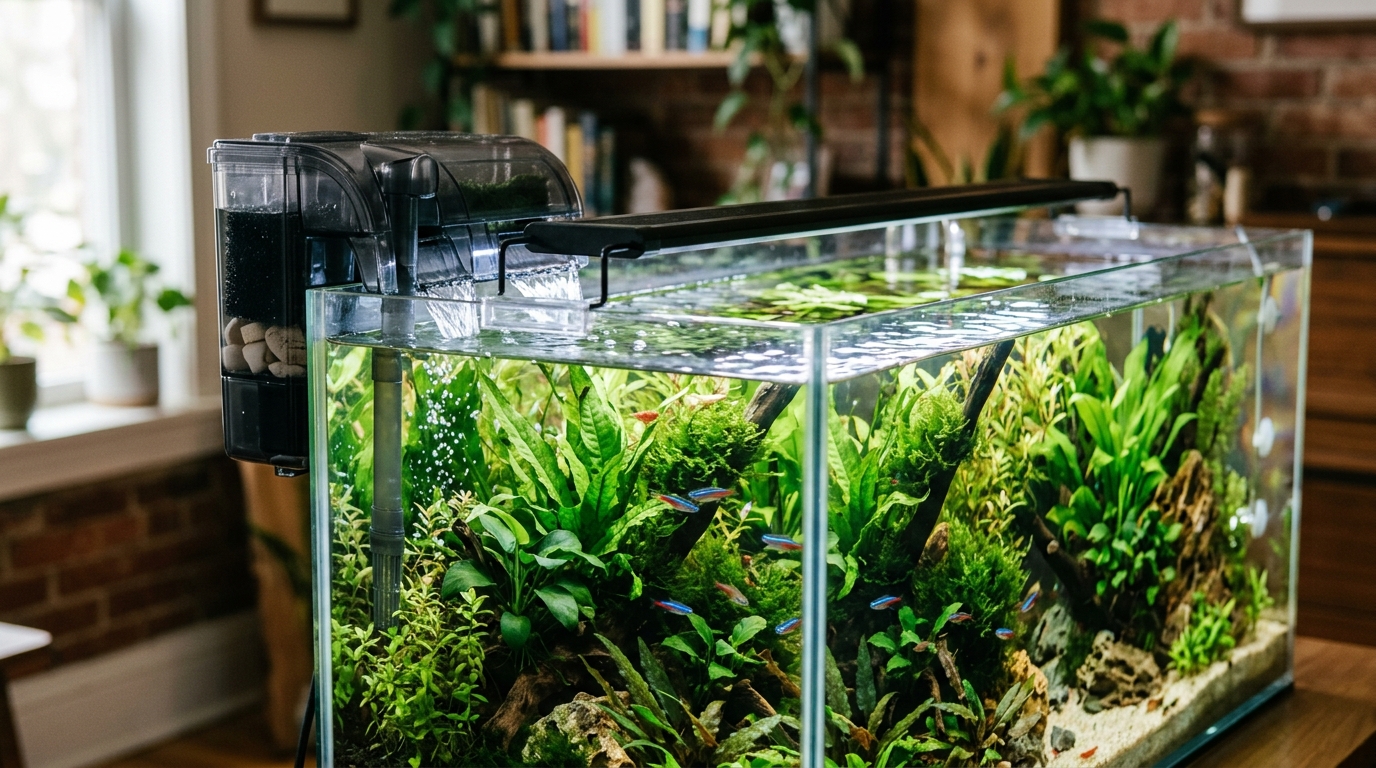
A hang-on-back filter hangs on the rim, pulls water up a U-tube, and returns it as a waterfall. You see the box. You also service the box in place. That is the whole pitch.
The Fluval AquaClear 50 (B000260FUM) is the named HOB in this pillar. Fluval rates it for 20–50 US gallons, with a large media basket, foam, carbon, and BIOMAX in the stock pack, plus an adjustable flow dial — specifications Fluval publishes on its own site. The 50 is the size people put on a 20-gallon planted tank when they want headroom instead of a 20-rated box running at the ceiling.
What you are buying is serviceability. Unplug, lift the cover, squeeze the intake sponge in a bucket of tank water, seat it wet, close, plug in. Monthly, look at the impeller. That is a five-minute job if the rim is honest.
Where AquaClear 50 loses: the box sits in the sight line. The waterfall can dent a delicate surface. Carbon in the stock pack will strip organics you may want to leave in a planted water column — you can simply not reinstall that bag. Rimless tanks may not have a rim to hang on. Tight lids need cutouts.
AquaClear 50 is the right default when the tank has a rim, you will actually rinse a sponge, and you do not want a cabinet full of hose. It is the wrong default when the scape is a lid-off rimless display and you already accepted canister plumbing.
Fluval AquaClear 50 Power Filter
Fluval
Hang-on-back AquaClear 50 for 20–50 gallon tanks, with a large media basket, foam, carbon, and BIOMAX, plus adjustable flow.
Before you click. Confirm the hang-on width against your rim or lid cutout. A 20–50 gallon rating is not a rimless-tank adapter. The stock pack still advertises carbon; you can simply not reinstall that bag. If the live photo shows a 20 or a 70 basket on a "50" title, skip it.
Canister: Fluval 107 as the named example
A canister sits in the cabinet. Intake and return hoses go over the rim. Media stacks in baskets. You get more volume and a hidden body. You also get priming, quick-disconnects, and a floor that can get wet if you skip the valves.
The Fluval 107 (B07JGLN6XC) is the named canister in this pillar. Fluval rates the 07-series 107 for 10–30 US gallons, with an AquaStop valve, stacked media baskets, and a pump in the 145 GPH class per Fluval's published specifications. That size band matches 10-gallon and 20-gallon planted tanks without jumping to a 307-class footprint.
What you are buying is media control and a cleaner rim. You can run sponge and ceramic and skip carbon. You can aim a spray bar along the rear glass instead of accepting a waterfall. You can hide the motor. If that spray bar is the part you already hate, the outflow upgrade is best lily pipe for a planted tank — glass, steel, or PETG, sized to the hose, not to the tank nickname.
Where the 107 loses: first prime. Hose kinks in a small cabinet. Impeller and seal service. Easy to over-aim the return and sandblast a stem line. If you will not haul a canister to a sink, you will not maintain it, and an unmaintained canister is just a sealed swamp.
Fluval 107 is the right default when you have a cabinet, you want the filter off the glass, and you will use the AquaStop like an adult. It is the wrong default when your "cabinet" is a nightstand with no door clearance.
Fluval 107 Performance Canister Filter
Fluval
Fluval 07-series canister rated for 10–30 US gallons, with AquaStop valve, stacked media baskets, and a 145 GPH pump class.
Before you click. Confirm hose diameter and that the AquaStop set is in the photo. A 10–30 gallon rating is not a promise that a nightstand "cabinet" has door clearance. Skip any row that still shows an undergravel plate as a planted-tank bonus.
Buying notes the listing will not write
Gallon ratings are starting bands. The filter you will service is the filter that works. Impeller access is the real monthly job; the listing will not show you the well. On the AquaClear, that well is under the lid. On the 107, it is inside a body you haul to a sink.
GPH on the box is open-air pump math. After sponges and a spray bar, the planted tank sees less. Aim the return along the rear glass, not at a substrate hill. If you are still choosing a light that will fight the lid, read Fluval Plant 3.0 vs Chihiros vs Twinstar in the same sitting as this page.
Service cadence, honestly: rinse mechanical media in a bucket of tank water, not straight chlorinated tap, whenever the return slows noticeably — the nitrifying film living in that foam is the part you are trying to keep. Swish biological media; never scrub it spotless. Replace chemical media on a schedule or drop it from the stack entirely; exhausted carbon is just gravel.
The two-SKU fight for 10–20 gallon tanks stays at Fluval 107 vs AquaClear 50. Keep both URLs.
HOB versus canister, in one table
| Question | Hang-on-back (AquaClear 50) | Canister (Fluval 107) |
|---|---|---|
| Service | In place, lid off | Valves off, body to a sink |
| Sight line | Box on the rim | Hoses only |
| Media | Basket; easy to skip carbon | Stacked baskets; easy to customize |
| Rimless tanks | Often needs an adapter or a different filter | Works if hoses clear the glass |
| CO2 atomizer | Ceramic disc in the tank | Disc or inline on the return |
| Failure mode | Waterfall noise, rim buzz | Prime mistakes, hose leaks |
| Best for | People who will rinse a sponge weekly | People who will rinse baskets monthly |
Neither column is a purity test. The filter you will service is the filter that works.
Listing check
Filter listings lead with gallon ratings and GPH. Those numbers do not tell you whether the box will hang on your rim or whether the hose kit will clear your cabinet. Before you follow a plantedtankreviews-20 link on this page:
- AquaClear 50: confirm the hang-on width against your rim or lid cutout. A 20–50 gallon rating is not a rimless-tank adapter.
- Fluval 107: confirm the hose diameter and that the AquaStop set is in the photo. A 10–30 gallon rating is not a promise that a nightstand "cabinet" has door clearance.
- Skip any row that still shows an undergravel plate as a planted-tank bonus. That is leftover kit hardware, not a recommendation from this site.
We do not paste the Amazon media-pack bullet list. Carbon in the stock basket is optional to reinstall; the listing will still advertise it.
Why undergravel stays off this list
Undergravel plates sit under the substrate and pull water down through the bed and up lift tubes. The design is decades old and it earned its reputation in bare-bottom community tanks, where nothing grew in the gravel. A planted tank is the opposite of that tank.
The bed is either aquasoil you do not want to fluidize or Flourite you do not want to pack into a plate grid. Roots grow into the grid, root tabs sit exactly where the plate wants clean flow, and every rescape means lifting the plate or tunneling around it. Vacuuming — normal in a fish-only tank — either starves the plate or rips the foreground.
Biology does not need the plate either. Modern planted tanks already carry more biological surface area in sponges and ceramic media than an undergravel plate provided, and you can rinse that media in a bucket of tank water without tearing out the foreground. If you inherit a tank with a plate already under the gravel, cap the lift tubes or research reverse-flow before running it; do not build a fresh planted bed on top of one on purpose. That is why the hard no repeats on this page: it is leftover kit hardware, not a planted-tank recommendation from this site.
The rest of the hardware stack
A filter never ships alone, and half of filter choice is fitting the other hardware around it:
- Light. Growth rate sets the waste load the filter has to keep pace with. Start at best planted tank lights 2026, and if you are down to brand-level picks, Fluval Plant 3.0 vs Chihiros vs Twinstar is the compare.
- Substrate. The bed decides what can live under it, which is the whole undergravel argument above. See best substrate for a planted tank.
- CO2. Pressurized tanks care where the mist lands; the return places it. See best aquarium CO2 kit.
- Outflow. A lily pipe turns a canister return from a firehose into a current. See best lily pipe for a planted tank.
- Heat. A heater is in-flow hardware too: mount it where the return pushes water past it, not in a dead corner behind driftwood. See best aquarium heater for planted tanks.
- The combined order. For a 20-gallon specifically, best light and filter for a 20-gallon planted tank is the shopping list, and Fluval 107 vs AquaClear 50 is the head-to-head underneath it.
Frequently asked questions
Is a hang-on-back or a canister better for a planted tank?
A hang-on-back is faster to service and cheaper to start. A canister hides the body and holds more media. Neither is universally better. Match the filter to the rim, the cabinet, and how often you will actually rinse sponges.
Should I use an undergravel filter in a planted tank?
No. Undergravel plates fight planted substrate. Roots, root tabs, and any soil or Flourite bed all work against a plate. Modern sponges and ceramics already provide biological surface area.
Do I need carbon in a planted filter?
Carbon is optional. Use it after a messy hardscape rinse or to pull tannins from new wood. Do not treat it as a permanent resident unless you like buying replacements. Planted tanks often run sponge plus ceramic only.
When should I skip a hang-on-back or a canister?
Skip AquaClear 50 on a rimless display you will not adapt, or if you already want lily pipes and an inline atomizer. Skip Fluval 107 if there is no cabinet, or if you will not prime and haul a body. Skip both if the listing still sells an undergravel plate as a planted bonus.
Which filter fits a 10-gallon cube versus a 20-gallon long?
A 10-gallon rimmed cube often wants a smaller hang-on-back; AquaClear 50 is oversized unless you baffle it. A hooded 20-high often wants AquaClear 50. A rimless 20-long with a real cabinet often wants Fluval 107. Measure the rim and the stand.